
You look in the mirror and barely recognize the person staring back. Dark circles have taken up permanent residence under your eyes.
Fine lines seem to have appeared overnight. Your skin looks dull, tired, older than it should.
You’ve tried the creams, the serums, even the expensive facials. Nothing works for long.
Here’s the connection between stress and skin health that dermatologists rarely mention and skincare companies don’t want you to know — your face is telling the story your body is living.
When stress becomes chronic, it doesn’t just affect how you feel. It literally changes how you look.1
In this article, you’ll discover the hidden pathways linking your stress levels to your skin condition, why your gut health determines how your face ages, and what ancient wisdom combined with modern science reveals about lasting solutions.
Keep reading because I’m about to reveal connections that explain why nothing you’ve tried has worked — and what actually does.
Key Takeaways
- Chronic stress triggers cortisol that breaks down collagen through pathways most doctors never test.2,6
- Your gut and skin communicate through a bidirectional axis that conventional dermatology ignores.3,9,12
- The stress-gut-skin connection creates a cycle that topical treatments alone cannot break.4,9,12
- Ancient stress management practices, backed by modern research, reduce stress hormones effectively.5
- Testing reveals hidden gut issues affecting your skin that standard medical exams miss.
- An integrated approach addressing stress, gut health, and clean beauty creates lasting transformation.
Ready to Support Your Skin from the Outside In?
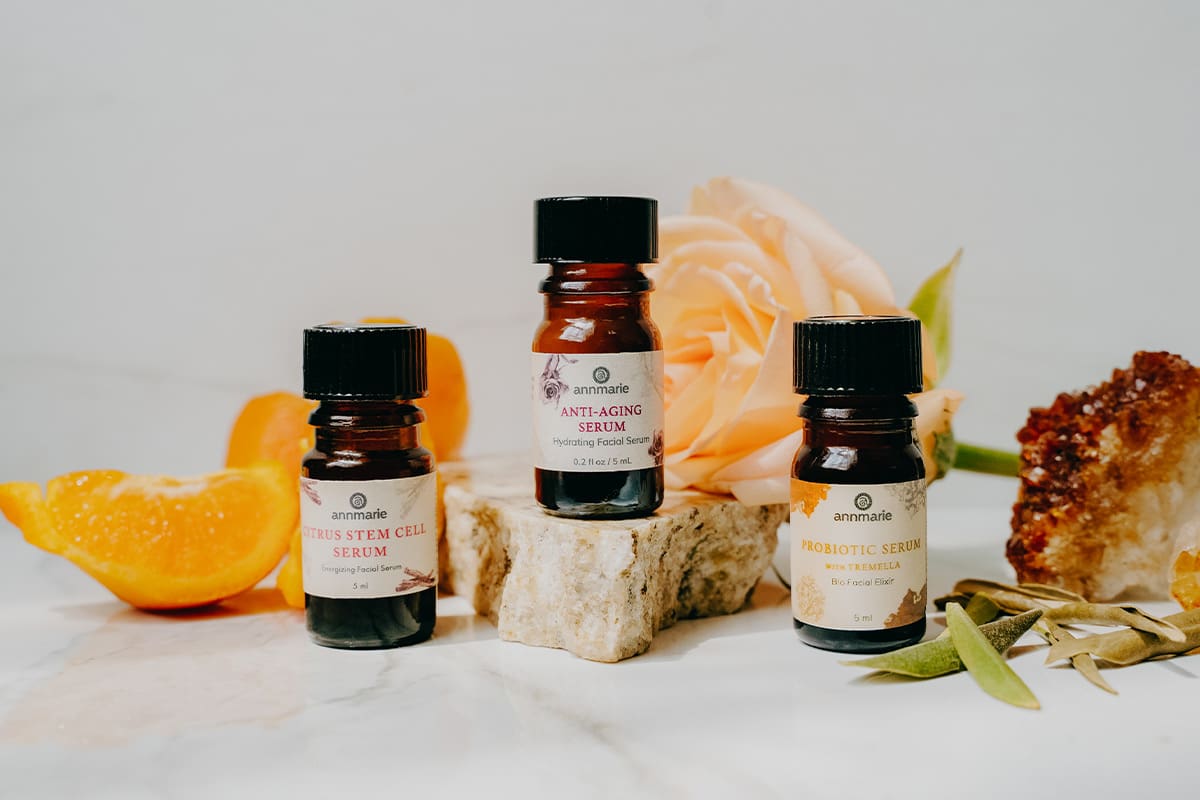
The Annmarie Skin Care Serum Trio delivers three clean, organic serums designed to work with your body’s natural healing process. Choose hydrating, brightening, or calming formulas without toxic burden.
Risk-free • Clean ingredients • Trusted by thousands
The Cortisol-Collagen Connection Dermatologists Miss
I’ve been working with patients for decades, and there’s a pattern conventional medicine consistently overlooks.
Someone comes in with accelerated aging, persistent breakouts, or chronic sensitivity.
They’ve seen dermatologists, tried prescription treatments, invested in expensive products.
Nothing addresses the real problem.
The stress and skin health connection runs through a biochemical pathway that standard dermatology rarely tests or treats.⁶
When you’re under chronic stress, your body continuously releases cortisol.⁶
Research shows that cortisol directly downregulates collagen type I production in human dermal fibroblasts — the cells responsible for keeping your skin firm and youthful.²
Studies document that prolonged cortisol exposure decreases collagen production and activates inflammatory pathways.⁷
In practical terms: elevated cortisol literally breaks down the scaffolding holding your skin together.
What you see in the mirror — fine lines, wrinkles, sagging, dullness — is your body’s stress response written across your face.
The Cortisol-Collagen Connection
How stress hormones accelerate visible aging
Chronic Stress Response
Your body perceives ongoing threat and activates HPA axis
Elevated Cortisol Production
Stress hormone floods your system continuously
Collagen Type I Shutdown
Cortisol directly downregulates collagen production in dermal fibroblasts
Accelerated Visible Aging
• Fine lines and wrinkles deepen
• Skin loses firmness and elasticity
• Dullness and uneven texture appear
💡 Key Insight: This pathway explains why topical anti-aging products alone don’t work long-term. Without addressing cortisol levels, you’re fighting a losing battle against your own stress hormones.
But this cortisol-collagen pathway is just the first connection nobody talks about.
The Gut-Skin Axis Nobody’s Testing
This is the connection that changed everything in my practice.
Your gut and your skin communicate constantly through what scientists call the gut-skin axis — a bidirectional relationship regulated by inflammatory mediators, the immune system, and metabolites.³
Most dermatologists don’t test for this. Conventional skincare completely ignores it.
Yet research demonstrates that gut dysbiosis plays a significant role in inflammatory skin conditions including psoriasis, atopic dermatitis, rosacea, and acne.⁸
Here’s how it works: When your gut microbiome becomes imbalanced, inflammation doesn’t stay localized.
It becomes systemic, traveling through your bloodstream and manifesting on your skin through compromised intestinal barriers and immune dysregulation.⁹
I’ve witnessed this pattern countless times.
Someone struggling with digestive issues and chronic fatigue also has persistent skin problems.
We address their gut health through testing, and their skin clears up — because we’ve addressed the primary cause.
Studies show that psychological stress deteriorates skin barrier function by activating the hypothalamic-pituitary-adrenal axis.¹⁰
This creates a vicious cycle: stress damages your gut, your damaged gut increases inflammation, that inflammation appears on your skin, and visible skin problems create more stress.
The Vicious Cycle
How stress, gut health, and skin problems perpetuate each other
🧠 Chronic Stress
Continuous cortisol release damages collagen production
🦠 Gut Dysbiosis
Microbiome becomes imbalanced, barrier function weakens
🔥 Systemic Inflammation
Inflammation travels through bloodstream to skin tissue
😰 Visible Skin Problems
Breakouts, aging, sensitivity manifest on skin surface
⚠️ Skin problems create MORE STRESS
…and the cycle continues
Breaking this cycle requires addressing all three elements simultaneously — stress management, gut healing, and supportive skincare.
Understanding the gut-brain connection reveals why this three-way relationship is so powerful.
The same pathways affecting your mental state also impact your skin.
The problem?
Standard medical workups don’t test for gut permeability or food sensitivities driving your skin issues.
You’re treating symptoms topically while the root cause continues unchecked.
Discover the Hidden Connections Affecting Your Skin
Comprehensive gut testing reveals hidden food sensitivities and gut permeability problems that standard medical tests miss. Know exactly what’s driving your skin symptoms instead of guessing.
Stop guessing • Start healing • Know your root cause
Why Conventional Treatments Keep You Stuck
Here’s the uncomfortable truth: most conventional treatments actually perpetuate the problem because they don’t address the stress and skin health connection.
The typical approach treats surface symptoms.
You see a dermatologist who prescribes topical treatments. You buy expensive skincare products.
Maybe you get professional treatments that temporarily improve appearance. But none address the stress-gut-skin axis.
Worse, many conventional products add to your problem.
Your skin absorbs what you apply to it.
When products contain parabens, synthetic fragrances, harsh preservatives, and chemical compounds, you’re adding to your body’s toxic burden while trying to heal.
During my training in Traditional Chinese Medicine, I learned about facial diagnosis — reading the face to understand internal imbalances.
Ancient practitioners understood what modern medicine is only now confirming: skin issues almost always reflect deeper systemic problems.
The Gut-Skin Axis
Bidirectional communication between your gut and skin
Your Gut Microbiome
Controls inflammatory responses throughout your body
When balanced: Produces anti-inflammatory compounds
When dysbiotic: Triggers systemic inflammation
↕ BIDIRECTIONAL COMMUNICATION ↕
Communication Pathways
Your Skin Health
Reflects what’s happening inside your gut
Healthy gut = Clear, radiant skin
Imbalanced gut = Breakouts, sensitivity, aging
📊 Clinical Evidence: Studies show gut dysbiosis plays a significant role in psoriasis, atopic dermatitis, rosacea, and acne. This connection explains why addressing gut health often resolves persistent skin issues.
Stress and gut health create a loop that conventional treatments don’t break.
You need an integrated approach addressing all three elements simultaneously.
The Three-Part Solution That Addresses Root Causes
Understanding the stress-gut-skin connection reveals something powerful: you need an integrated approach addressing all three simultaneously.
Here’s what actually works:
Address Stress at Its Source
Research shows that mindfulness practices can help reduce cortisol levels, while specific breathing exercises practiced for ten minutes daily show potential in lowering stress hormones.⁵
These aren’t just relaxation techniques — they’re directly targeting the biochemical pathways damaging your skin.
The practices work because they activate your parasympathetic nervous system, signaling your body it’s safe to stop producing excessive cortisol.
When cortisol levels normalize, your skin’s collagen production can recover.
Ancient meditation and breathwork practices, now validated by modern research, offer proven methods for regulating stress hormones without pharmaceutical intervention.13
Heal the Gut-Skin Connection
Testing reveals what standard medical exams miss.
Food sensitivities, gut permeability issues, and microbiome imbalances all impact your skin.
When you know exactly what’s wrong, you can address the specific causes rather than guessing.
I’ve seen people spend years and thousands of dollars on skincare products while their gut issues continue driving inflammation.
The moment they addressed their gut health through proper testing and targeted protocols, their skin transformed — because we stopped treating symptoms and started addressing causes.
Research confirms that stress directly impairs digestive processes and gut barrier integrity.¹¹
This creates a perfect storm: stress damages your gut, your damaged gut can’t properly absorb nutrients needed for healthy skin, and the resulting inflammation manifests as skin problems.
The gut-brain-skin axis works bidirectionally.
Healing your gut doesn’t just improve digestion — it reduces systemic inflammation affecting every organ, including your skin.
Stop Guessing. Start Healing With Comprehensive Testing.
Comprehensive gut testing reveals hidden food sensitivities, gut permeability issues, and microbiome imbalances that standard medical tests miss. Know exactly what’s driving your skin issues instead of trying product after product hoping something works. Get your personalized roadmap to clear, healthy skin by addressing the root cause.
End the guesswork • Targeted solutions • Real results
Use Clean Skincare That Supports Natural Processes
The Annmarie Skin Care Serum Trio exemplifies this approach — organic, wildcrafted ingredients formulated without toxins. When you’re working to heal from the inside out, the last thing you need is additional chemical burden from what you apply topically.
Clean skincare isn’t about perfection — it’s about removing obstacles to your body’s natural healing capacity.
When you eliminate products adding to toxic burden, you free up your system’s resources for actual repair and regeneration.
Choose products with ingredients you recognize, formulated to work with your skin’s natural processes rather than overriding them.
Look for transparency in sourcing and manufacturing, supporting rather than disrupting the skin barrier function that stress has already compromised.
Support Your Skin’s Natural Healing Process
The Annmarie Skin Care Serum Trio delivers three clean, organic serums formulated to work with your body — not against it. Choose from hydrating, brightening, or calming formulas tailored to your skin’s specific needs. Experience professional-grade clean skincare without toxic burden.
Professional-grade • Organic • Support your body’s wisdom
Why This Integrated Approach Actually Works
Each element addresses one part of the stress-gut-skin connection.
Together, they create synergistic effects exceeding what any single approach could achieve.
Stress management techniques reduce cortisol production, protecting your collagen.
Gut healing reduces systemic inflammation manifesting on your skin.
Clean skincare removes additional burden while supporting natural barrier function.
Add clean, supportive skincare that doesn’t add toxins, and you’ve freed up resources your body can redirect toward actual healing.
This is what I mean by an integrated approach. It’s understanding how these elements work together to create results exceeding the sum of their parts.
Your Action Plan
Here’s how to start addressing the stress and skin health connection today.
Morning:
Before reaching for your phone, spend two minutes on 4-count breathing.
This activates your parasympathetic nervous system and immediately begins reducing cortisol.
After cleansing, apply your clean serum to damp skin.
The smaller molecular size penetrates deeper, delivering active ingredients where needed.
Throughout the day:
Notice when stress builds.
Take micro-breaks for conscious breathing.
Energy management techniques matter more than time management for stress resilience.
Evening:
Create a wind-down routine signaling your body it’s safe to rest.
This supports both better sleep quality and skin repair, since cellular regeneration happens during deep sleep.
Ongoing:
If you haven’t identified your specific gut-skin triggers, get tested.
Knowing exactly what foods trigger inflammation, whether you have intestinal permeability issues, and what’s happening with your microbiome gives you a roadmap instead of guessing.
The key is consistency with an integrated approach.
Small daily practices addressing stress, gut health, and clean skincare compound over time, creating lasting change.
Understanding Changes Everything
The stress and skin health connection nobody talks about — including the gut-skin axis, the cortisol-collagen pathway, and how conventional treatments often perpetuate problems — changes your entire approach.
You stop looking for the next miracle cream and start addressing root causes.
You recognize that your digestive symptoms and skin issues aren’t separate problems.
You understand why stress management isn’t optional — it’s foundational.
This perspective comes from both ancient wisdom and modern research.
Traditional Chinese Medicine practitioners understood facial diagnosis centuries ago.
Modern science now validates these connections through studies on the gut-skin axis and cortisol’s effects.2,12
The beauty of this understanding? You finally know what to address.
No more throwing money at products treating symptoms while causes continue.
No more confusion about why nothing works long-term.
More importantly, understanding these connections reveals the solution: an integrated approach addressing stress management through proven practices, gut healing through testing and targeted protocols, and clean skincare supporting your body’s natural processes.
Start With What Works
You don’t have to figure this out alone.
Start with clean skincare working with your body.
The Annmarie Serum Trio gives you three options — all formulated with organic, wildcrafted ingredients. At 74% off, it’s a low-risk way to experience clean, effective skincare.
Build your stress resilience with Temple Grounds — ancient practices validated by modern research on cortisol reduction and nervous system regulation.
If you’re dealing with persistent skin issues alongside digestive symptoms, get tested instead of guessing. Know what’s actually wrong and save years of trial and error.
Your skin reflects your internal state.
When you nurture that state with practices reducing stress, protocols for healing inflammation, and clean products supporting natural processes, your skin responds.
The transformation happens from the inside out.
You deserve to feel confident in your skin again.
The path forward starts with understanding the real connections — then taking action on all three levels.
Sources
- Pujos, M., Chamayou-Robert, C., Parat, M., et al. (2024). Impact of Chronic Moderate Psychological Stress on Skin Aging: Exploratory Clinical Study and Cellular Functioning. Journal of Cosmetic Dermatology.
- Chase, M. (2021). AP Collagen Peptides Prevent Cortisol-Induced Decrease of Collagen Type I in Human Dermal Fibroblasts. International Journal of Molecular Sciences.
- Jimenez-Sanchez, M., et al. (2025). The gut-skin axis: a bi-directional, microbiota-driven relationship with therapeutic potential. Gut Microbes.
- Leigh, S.J., et al. (2023). The impact of acute and chronic stress on gastrointestinal physiology and function: a microbiota–gut–brain axis perspective. The Journal of Physiology.
- Obaya, H., et al. (2023). Effect of aerobic exercise, slow deep breathing and mindfulness meditation on cortisol and glucose levels in women with type 2 diabetes mellitus: a randomized controlled trial. Frontiers in Physiology.
- Chen, Y., Lyga, J. (2014). Brain-Skin Connection: Stress, Inflammation and Skin Aging. Inflammation & Allergy – Drug Targets.
- Tollenaere, M., et al. (2021). Well-aging: A new strategy for skin homeostasis under multi-stressed conditions. Journal of Cosmetic Dermatology.
- Salem, I., Ramser, A., Isham, N., Ghannoum, M.A. (2018). The Gut Microbiome as a Major Regulator of the Gut-Skin Axis. Frontiers in Microbiology.
- Pessemier, B., et al. (2021). Gut–Skin Axis: Current Knowledge of the Interrelationship between Microbial Dysbiosis and Skin Conditions. Microorganisms.
- Choe, S.J., Kim, D., Kim, E.J., et al. (2018). Psychological Stress Deteriorates Skin Barrier Function by Activating 11β-Hydroxysteroid Dehydrogenase 1 and the HPA Axis. Scientific Reports.
- Russo, S., et al. (2023). Stress-activated brain-gut circuits disrupt intestinal barrier integrity and social behaviour. Research Square.
- Ferraretto, A., et al. (2023). Editorial: The gut-skin-brain axis in human health and disease. Frontiers in Nutrition.
- Örün, D., et al. (2021). The Effect of Breathing Exercise on Stress Hormones. Cyprus Journal of Medical Sciences.