
Dr. Pedram Shojai
Episode Description:
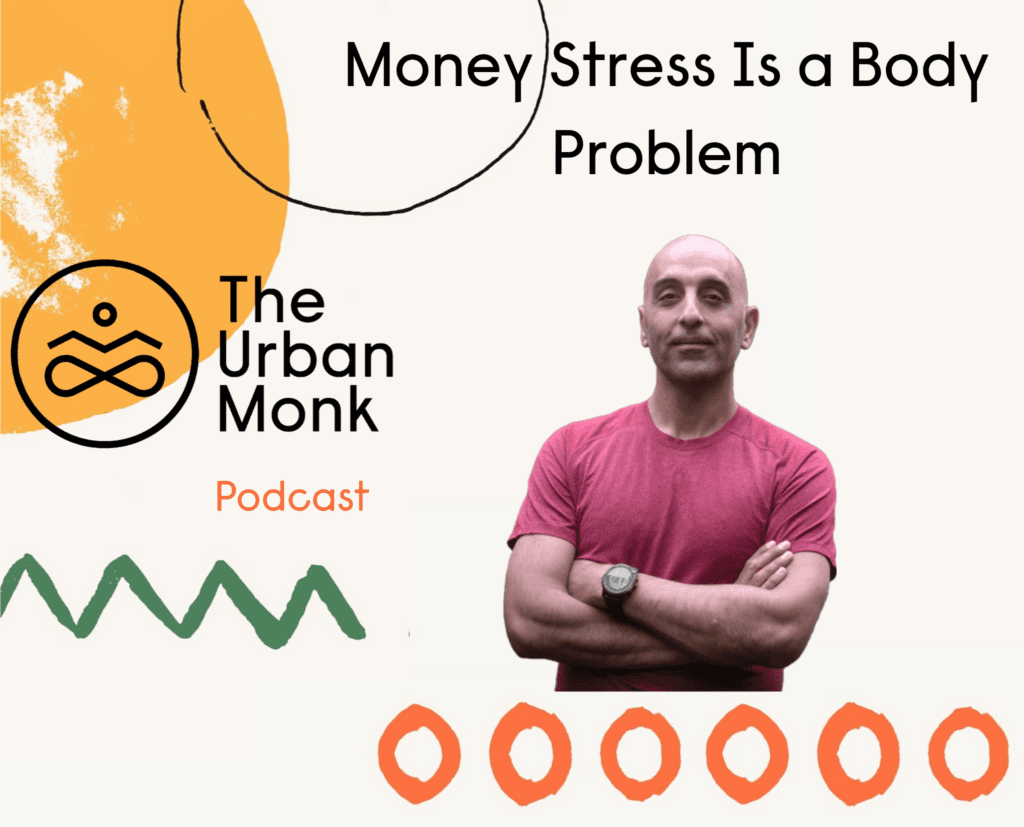
Money stress is a physical experience, not a mindset problem. Dr. Pedram Shojai opens by naming what wellness spaces rarely do: a lot of people are under real financial pressure, and the nervous system reads a low bank balance the same way it reads a predator. He walks through the documented biology of chronic financial stress, from HPA axis dysregulation and immune suppression to collapsed sleep and narrowed cognition.
The core teaching introduces three intervention gates from the Lights On framework: resetting vagal tone to interrupt the cortisol loop, shifting from scarcity to resource awareness through somatic anchoring, and tracing the body’s patterned relationship with money back to early conditioning. Pedram leads the group through a live Financial Body Scan practice that integrates all three.
The episode closes with an honest disclaimer: body practices don’t fix financial problems. Real circumstances require real solutions. But you can’t think your way out of a mess from inside a chronic threat response. The work restores the nervous system capacity needed to pursue solutions clearly.
Listen to the episode on Spotify here or on your favorite podcast platforms and check out the Free 5-Day Reset here.
Podcast show notes:
[00:00] Money Stress Is a Real Health Problem
- Financial pressure is one of the most robust predictors of immune dysregulation in the literature, yet wellness spaces rarely address it directly.
- When the account balance drops below what it needs to be, the nervous system reads it as a continuous threat response, not a mindset problem.
- Chronic HPA axis activation produces measurable, documented downstream effects that look like and often become chronic illness.
[02:00] The Biology of Financial Stress
- The HPA axis was built for threats that resolve. A credit card balance that’s been there for four years has no resolution signal.
- Sustained cortisol elevation causes immunosuppression, decreased natural killer cell activity, impaired T cell response, and elevated inflammatory cytokines.
- A 2013 meta-analysis in Psychological Bulletin reviewed 300 studies confirming chronic psychological stress as a primary driver of immune dysregulation.
[05:00] Cardiovascular and Sleep Consequences
- A landmark European Heart Journal study found financial strain independently associated with a 13% increased risk of cardiovascular events.
- Mechanisms include elevated blood pressure, reduced heart rate variability, endothelial inflammation, and accelerated arterial plaque formation.
- Financial anxiety suppresses melatonin, delays sleep onset, and fragments slow-wave sleep, compounding cortisol elevation the following day.
[07:00] Scarcity Narrows the Mind
- Mullainathan and Shafir’s scarcity research demonstrated that financial stress measurably reduces cognitive bandwidth and IQ-equivalent performance on reasoning tasks.
- The result: worse financial decisions made under exactly the conditions that require better ones.
- “I’m so broke I can’t even pay attention.” It’s a real thing.
[08:30] Financial Stress as Physical Pain
- A 2011 UCLA neuroimaging study found that social and economic exclusion activates the dorsal anterior cingulate cortex and anterior insula, the same regions that process physical pain.
- A nervous system reading its financial environment as chronically unsafe cannot fully access the parasympathetic state required for healing or clear thinking.
- You can’t fully meditate your way into presence while the nervous system is still running a survival threat response from checking your account.
[11:00] The Three Intervention Gates
- Gate one: a neuroceptive reset through vagal tone, using slow exhale breathing, cold water, humming, or gargling to interrupt the threat chemistry.
- Gate two: a scarcity-to-resource shift, physically registering what is present and sufficient right now through interoception and exteroception, not positive thinking.
- Gate three: identifying where money stress lives in the body and tracing it back to early patterning, separating old financial conditioning from the current reality.
[17:00] The Body’s Relationship with Money
- The chest tightening when opening a bill or the gut drop when checking the account is likely not a response to current numbers. It’s an old pattern activating in a current context.
- As long as inherited financial fear and present-tense data are fused, you can’t see the current situation accurately.
- Gate three is somatic witness practice applied specifically to the charge around money.
[20:00] Live Financial Body Scan Practice
- Pedram leads the group through a three-step somatic practice: bring the financial reality to mind, drop attention into the body and map the sensation precisely, then introduce a resource anchor without leaving the body.
- The bilateral holding of difficulty and resource simultaneously is what allows the nervous system to begin discharging chronic threat activation.
- You’re not trying to feel better about your finances. You’re trying to feel your finances from a nervous system that can think clearly about them.
[28:00] What This Practice Is and Isn’t
- Real financial pressure requires real-world solutions: fix the income, reduce the expenses, restructure the debt, change the circumstances.
- Body practices restore the nervous system’s capacity to pursue those solutions with full cognitive function rather than from inside the fog of sustained cortisol.
- Within a Daoist framework, you can’t navigate the terrain clearly while your perceptual system is in survival mode. Restore the system first, then navigate.
[30:30] The 24-Hour Challenge
- Body practice: run the Financial Body Scan once today, once before sleep, and once tomorrow morning. Track whether the quality of the sensation changes across sessions.
- Practical practice: identify one financial uncertainty currently running in the background. Open it, not to solve it today, but to look at it clearly with a regulated nervous system.
- The avoidance of financial reality is itself a significant driver of HPA activation. Clarity about a difficult reality is less physiologically costly than chronic unresolved uncertainty.
Key Takeaways
- Money stress is not a mindset problem. It is a documented biological process with measurable downstream effects on immunity, cardiovascular health, sleep, and cognition.
- The HPA axis was designed for threats that resolve. Chronic financial pressure never resolves, so the stress response never turns off.
- Financial stress measurably reduces cognitive bandwidth, making worse decisions more likely under exactly the conditions that require better ones.
- Vagal tone and HPA activation are mutually exclusive. You cannot be in genuine parasympathetic dominance and sustained cortisol release at the same time.
- The physical signature of money anxiety in the body is often old inherited patterning, not purely a response to current circumstances.
- The goal of body practices is not to feel better about your finances. It is to restore the nervous system capacity needed to think clearly about them.
Resources Mentioned
- Mullainathan and Shafir, Scarcity: Why Having Too Little Means So Much
- 2013 meta-analysis on chronic stress and immune dysregulation, Psychological Bulletin
- European Heart Journal study on financial strain and cardiovascular risk
- 2011 UCLA neuroimaging study on economic exclusion and pain processing
- Barbara Fredrickson, broaden-and-build theory, University of North Carolina
- Urban Monk Academy Lights On curriculum
This episode is for educational purposes only and not intended as medical advice. Consult with qualified healthcare practitioners for personalized guidance.
www.theurbanmonk.com