
Chronic exhaustion recovery doesn’t start with your schedule
You’ve taken the time off. You’ve slept in. You’ve cut back on caffeine. And the exhaustion is still there — heavy, persistent, and frankly infuriating.
Here’s what I’ve seen in decades of clinical practice: most people chasing chronic exhaustion recovery are looking in the wrong place.
They’re optimizing their schedule when the real problem lives in their nervous system.
In this article, I’ll walk you through what’s actually happening in your body when exhaustion won’t budge, and the specific steps that move the needle.
There’s also a section on tools I genuinely recommend — including one backed by a 2025 randomized controlled trial — so keep reading.
Key Takeaways
- Chronic exhaustion is often a sign of nervous system dysregulation, not simply a sleep deficit or a time management problem.²,⁶
- The HPA axis (your body’s central stress response system) can get stuck in overdrive — and rest alone won’t reset it.²,³,⁷
- There are two distinct types of exhaustion-related burnout, and they require different recovery approaches.
- Vagus nerve stimulation is one of the most evidence-backed pathways to restoring nervous system balance.⁴,⁸
- A 2025 RCT published in The American Journal of Medicine found that consistent vagus nerve support reduced burnout by 32% in just 12 weeks.¹
- Sustainable energy recovery requires working at the level of perception and operating system — not just habits.
- You can start rebuilding nervous system resilience today with practices that take less than 20 minutes.
Ready for the Next Step?
Turn these principles into your permanent operating system — so exhaustion stops being your default.
Lights On
Your complete system for lasting nervous system transformation
Why rest isn’t fixing your exhaustion
I want to be clear: your doctor isn’t wrong to tell you to rest more. Rest is necessary.
But it isn’t sufficient when your nervous system has been in chronic stress activation for months or years.
Here’s the biology: when you’re under sustained stress, your hypothalamic-pituitary-adrenal (HPA) axis — the command center of your stress response — goes into dysregulation.²,⁷
Cortisol, which should rise and fall in a predictable daily rhythm, starts to behave unpredictably. It spikes when it shouldn’t and flatlines when you need it most.
Research shows that prolonged HPA activation eventually produces an exhaustion that doesn’t improve with downtime.³
This is why people describe feeling “wired but tired” — their body is still firing stress signals even as their reserves run dry.
What conventional medicine does well is identify the acute end of this spectrum. What it sometimes misses is the middle ground — the person who isn’t in crisis but hasn’t felt like themselves in years.
The person who has had every test run, been told everything looks fine, and is still dragging through the day.
If that’s you: you’re not imagining it. The system is dysregulated, and it’s addressable. You can read more about reversing chronic stress effects in your body here.
How the HPA Axis Gets Stuck
Your body’s stress command center under chronic activation
The HPA Pathway
Hypothalamus
Pituitary
Adrenal Glands
✓ Normal Cortisol Rhythm
Predictable daily pattern with natural rise and fall
✗ Dysregulated Cortisol
Erratic spikes and crashes — unpredictable timing
Result: Exhaustion that doesn’t improve with downtime alone
The two types of exhaustion burnout — and why it matters
Not all burnout looks the same, and treating them identically is one of the most common mistakes I see.
The first type is sympathetic overdrive.
You can’t wind down. You lie awake replaying conversations. You feel like you’re always one notification away from another crisis. Your body is stuck in a loop of activation it can’t exit.
The second type is parasympathetic shutdown.
This one looks like depression on the surface — no motivation, emotional flatness, the inability to feel joy in things that used to matter.
If sympathetic overdrive is a car with the gas pedal stuck, parasympathetic shutdown is one that’s completely out of fuel.
The recovery approach differs for each.
Sympathetic overdrive needs practices that activate the brake — the parasympathetic nervous system.
Parasympathetic shutdown needs gentle re-activation, not more rest.
Most generic advice doesn’t make this distinction, which is why it helps some people and does nothing for others. Understanding which state you’re in is the real starting point for daily nervous system regulation.
The vagus nerve is your body’s recovery switch
Your vagus nerve is the longest nerve in your body, running from your brainstem down through your heart, lungs, and gut.
It’s the primary highway of your parasympathetic nervous system — the “rest and digest” counterpart to fight-or-flight.
When vagal tone is high, you recover faster from stress, your heart rate variability improves, digestion works better, and emotional regulation becomes easier.
When chronic stress suppresses vagal tone, all of those systems suffer together. This is also why stress and gut health are so deeply connected — the vagus nerve is a shared pathway.⁴
The Vagus Nerve: Your Recovery Highway
The longest nerve in your body — your parasympathetic nervous system’s main pathway
The Pathway
🧠 Brainstem
Command center
❤️ Heart
Heart rate variability
🫁 Lungs
Breathing regulation
🦠 Gut
Digestion & microbiome
✓ High Vagal Tone
• Faster stress recovery
• Better heart rate variability
• Improved digestion
• Easier emotional regulation
✗ Low Vagal Tone
• Prolonged stress response
• Poor recovery capacity
• Digestive dysfunction
• Emotional dysregulation
Good News: Vagal tone is trainable through breath, movement & sensory practices
The good news is that vagal tone is trainable.
Diaphragmatic breathing, humming, cold water on the face, and certain movement practices all activate the vagus nerve through its sensory branches.⁵
These aren’t just relaxation techniques — they’re direct inputs into the nervous system’s recovery circuitry.⁸
Start With the Fundamentals
Five days to shift how your nervous system perceives and processes daily demands.
Free 5-Day Reset
Many report their best sleep in years by night two
100% free • No credit card • No catch
What a 2025 clinical trial found about passive nervous system support
One of the most interesting pieces of research I’ve seen recently comes from a randomized controlled trial published in The American Journal of Medicine in 2025.¹
Sixty-six students in high-pressure medical and pharmacy programs were split into two groups — one used the Apollo Neuro wearable for 12 weeks, the other did not.
The results were notable.
The Apollo Neuro group showed a 32% reduction in burnout scores (measured by the Maslach Burnout Inventory), a 22% improvement in overall wellbeing, and a 23% reduction in perceived stress.¹
What makes this relevant to chronic exhaustion recovery isn’t just the numbers — it’s the mechanism.
Apollo Neuro works by delivering low-frequency vibrations that activate the body’s natural safety response through the vagus nerve.
There’s no training required. No time commitment beyond wearing it. It runs in the background while you work, rest, or sleep. For people who are already maxed out on bandwidth, that matters.
You’re not adding another practice to your morning routine. You’re supporting your nervous system’s recovery while living your life.
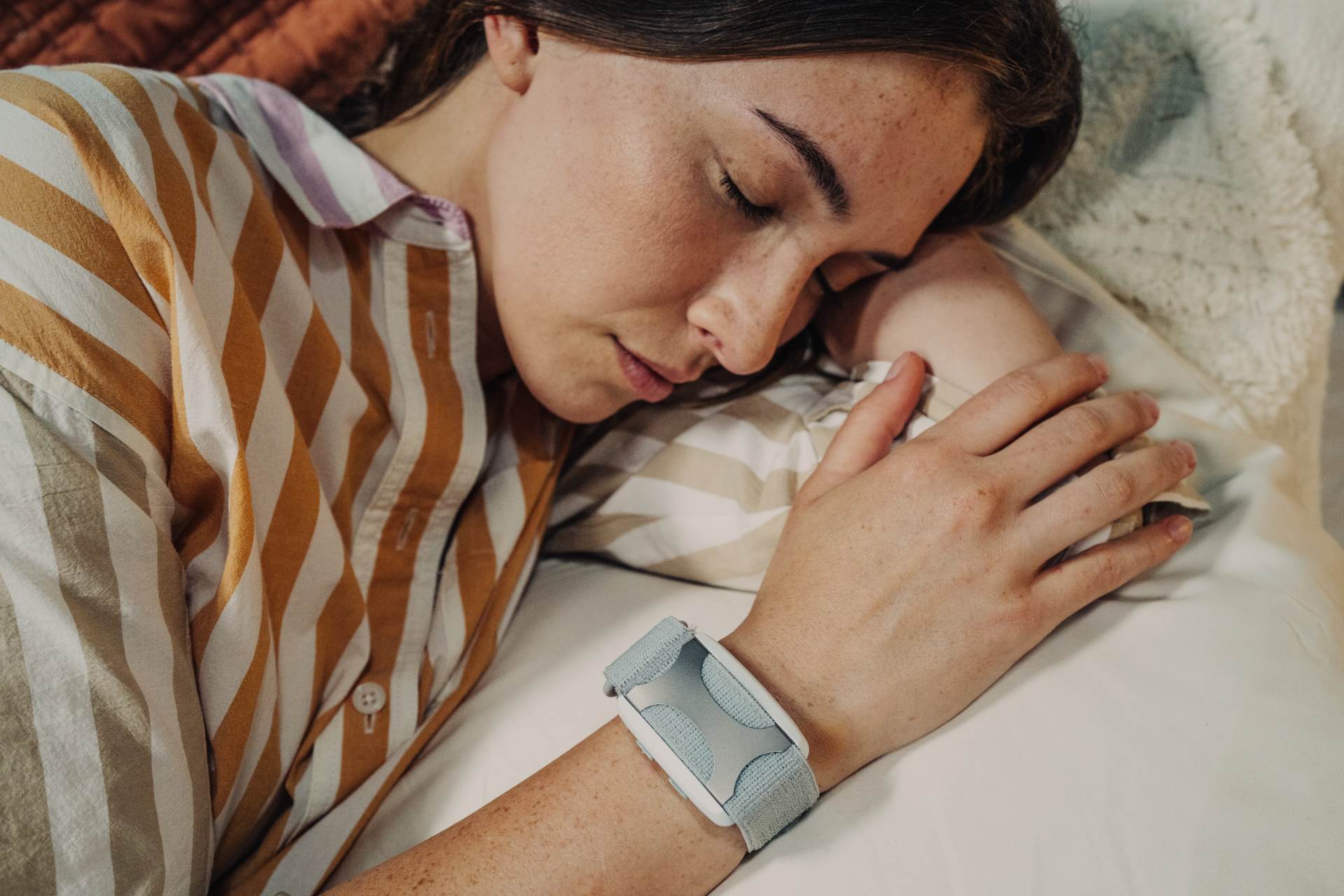
The Wearable from the Study
32% burnout reduction in 12 weeks — passive nervous system support that works in the background.
Apollo Neuro
Science-backed vagus nerve activation • No training needed • Works while you live
Exclusive Urban Monk pricing available
From reset to permanent change
I want to be honest about something I see all the time.
People find a practice that works — breathwork, Qigong, better evening boundaries. They feel better for a few weeks. Then a deadline hits, travel comes up, and they’re right back where they started.
That’s not a willpower failure. It’s a system failure. Individual practices without a coherent operating system will always be fragile.
This is the problem Lights On was built to solve.
It’s a program that doesn’t just teach nervous system practices — it systematically rebuilds how you operate.
Starting with perceptual expansion (your brain processes information through more channels than most people ever develop), moving through sleep architecture, energy alchemy, and stress mastery, the curriculum is designed so transformation is permanent rather than temporary.
One student, Helen, shared after her first week:
“I really enjoy the 3-2-1 practice. I am doing it before getting out of bed and finding myself stopping during the day and just expanding my awareness and using my senses… I can feel the shift. Loving it!”
That small shift, practiced consistently over 52 weeks, becomes a different way of living.
From Fragile Practices to Permanent Change
Stop reverting when life gets hard. Build a complete operating system that lasts.
Lights On
Systematic nervous system rebuilding • Perceptual expansion • Sleep architecture • Energy alchemy • Stress mastery
What your body actually needs right now
Here’s a practical framework for wherever you are in your chronic exhaustion recovery:
Morning (5–10 minutes): Diaphragmatic breathing before you check your phone.
Make your exhale longer than your inhale — this directly activates the vagus nerve.⁵ Even three minutes shifts your cortisol trajectory for the entire morning.
Midday (3 minutes): A brief reset before your afternoon.
Close the tabs, breathe, and consciously recalibrate before your nervous system starts accumulating stress again. This one interruption prevents the 3pm wall.
Evening: A genuine shutdown ritual — not just collapsing on the couch.
A deliberate transition that signals to your nervous system that the threat-scanning can stop. This is where stress resilience practices compound over time.
Make It Actually Stick
Turn these daily resets into nervous system resilience that lasts — week by week.
Lights On
Progressive curriculum that builds lasting resilience — so you stop reverting when life gets hard
The bottom line
Chronic exhaustion recovery isn’t about finding more time to rest. It’s about teaching your nervous system that the emergency is over.
That work happens through the HPA axis, the vagus nerve, and the stress response circuitry that’s been running in the background of your life for too long.
The practices exist. Science supports them. The tools are accessible.
You’ve already tried resting. Now it’s time to actually recover.
Ready to Start?
Choose the path that matches where you are right now.
Done Running on Borrowed Energy?
The complete system for permanent nervous system transformation
Just Beginning Your Journey?
5 days • No cost • Practices people wish they’d found years ago
Either way, you’re taking the first step toward genuine recovery.
Sources
- Evaluating the Impact of Apollo Neuro™ Wearable on Wellbeing in Medical and Pharmacy Students: A Preliminary Prospective Randomized Controlled Study. The American Journal of Medicine. 2025.
- Frontier studies on fatigue, autonomic nerve dysfunction, and sleep-rhythm disorder. The Journal of Physiological Sciences. 2015.
- A new view on hypocortisolism. Psychoneuroendocrinology. 2005.
- The vagus nerve at the interface of the microbiota-gut-brain axis. Frontiers in Neuroscience. 2018.
- How breath-control can change your life: a systematic review on psycho-physiological correlates of slow breathing. Frontiers in Human Neuroscience. 2018.
- Determining the direction of prediction of the association between parasympathetic dysregulation and exhaustion symptoms. Scientific Reports. 2022.
- An Integrative Approach to HPA Axis Dysfunction: From Recognition to Recovery. American Journal of Medicine. 2025.
- Vagus nerve and vagus nerve stimulation, a comprehensive review: Part I. Headache: The Journal of Head and Face Pain. 2016.