
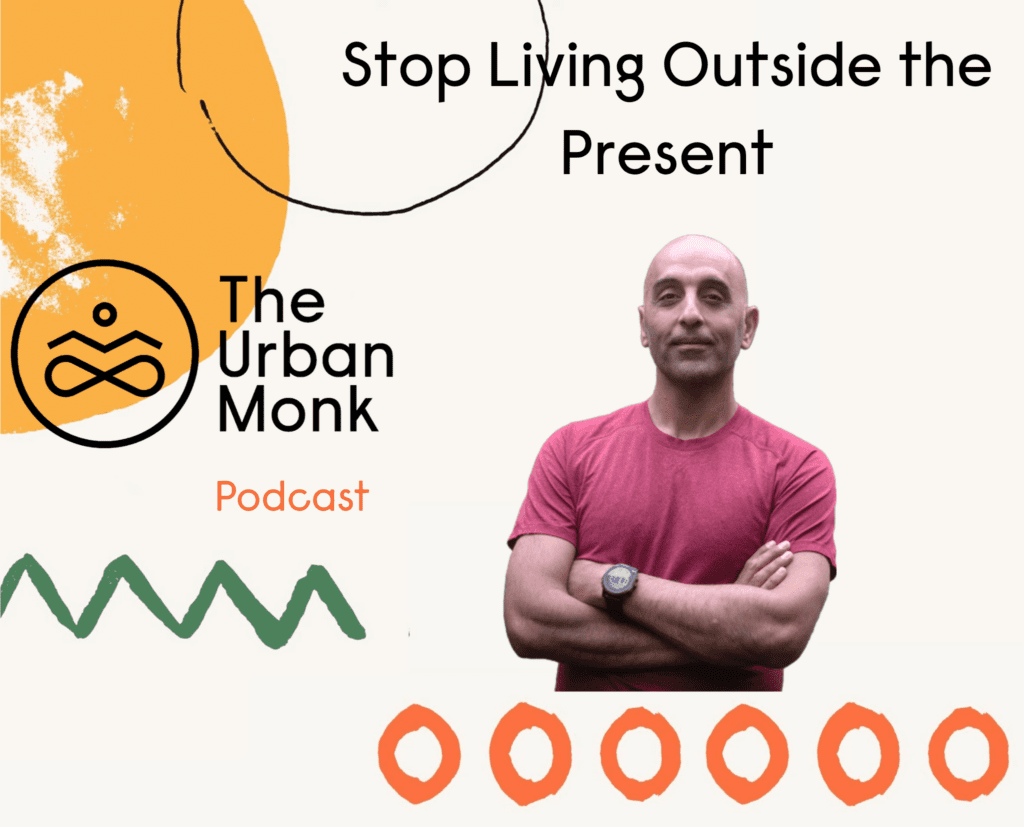
Dr. Pedram Shojai
Episode Description:
Pedram builds a scientific and contemplative case for why the present moment is the only place anything is actually happening. Drawing on Einstein, Carlo Rovelli, Julian Barbour, and David Eagleman, he shows that modern physics and neuroscience have arrived at the same conclusion the contemplative traditions reached thousands of years ago: past and future are mental constructions, not real locations. He then introduces three temporal traps: rumination, anxiety projection, and planning trance, and leads listeners through a four-step return practice to find their way back to the present.
Listen to the episode on Spotify here or on your favorite podcast platforms and check out the Free 5-Day Reset here.
Podcast show notes:
[00:00:00] Welcome and Course Context
- Pedram introduces the episode as an excerpt from the Lights On course, focused on waking up to inner light and returning to presence
- Full course available at lightson.theurbanmonk.com
[00:01:00] Where Is the Past?
- Pedram opens with a direct exercise: try to find the past. It has no location, no mass, no measurable presence in the universe
- Most of us spend the majority of our mental life replaying what happened or rehearsing what might happen, consuming our only real asset in real estate that doesn’t exist
[00:04:00] The Physics of Time
- Einstein’s special relativity established there is no universal present moment; the block universe holds that past, present, and future all exist equally in the structure of space-time
- Julian Barbour and Carlo Rovelli built on this: time is not fundamental but emergent, and the equations governing quantum mechanics contain no time variable
- Even Lee Smolin’s dissent lands at the same practical conclusion: only the present moment exists
[00:13:00] The Neuroscience of Now
- David Eagleman’s research: the brain actively constructs time; the present moment you experience is already 80 milliseconds old by the time it’s assembled
- Time expands in flow states and novel experience, contracts during distracted habitual activity
- Killingsworth and Gilbert (2010): the human mind wanders 47% of waking hours, and predicts lower happiness regardless of where it wanders
[00:17:00] What the Contemplative Traditions Knew
- Taoist understanding: Wu Wei points to alignment with what is present rather than acting from projected past or anticipated future; Pedram’s teacher Sher Liu: “The masters are not free from time. They are free in time.”
- Eckhart Tolle’s core thesis: psychological suffering is produced not by circumstances but by temporal displacement
- Buddhist impermanence (Anicca): the present itself has no fixed existence, confirmed by Eagleman’s neuroscience
[00:24:00] The Practical Convergence
- When the mind time-travels, the body responds as if those events are current: cortisol rises, muscles brace, the nervous system activates around circumstances that are not occurring
- That gap between where the mind is and where the body is constitutes internal fragmentation, a primary driver of chronic stress
[00:28:00] The Three Temporal Traps
- Rumination loop: the mind’s compulsive return to past events without resolution; physiologic signature includes contracted attention, chest heaviness, jaw tension
- Anxiety projection: simulating negative future outcomes; physiologic signature includes shallow breathing, chest tightening, shoulder elevation
- Planning trance: perpetual orientation toward the next thing; feels virtuous but locates attention in a temporal location that doesn’t exist
[00:35:00] The Return Practice
- Step 1: Locate the present. What is actually happening right now in the body (breath, weight, sound, temperature)
- Step 2: Notice where you were. Name the pattern without judgment: rumination, projection, or planning trance
- Step 3: Return to the breath. It is always present tense and cannot be past or future
- Step 4: Rest 30 seconds and let one recognition land: the past and future are thoughts occurring right now, not elsewhere
[00:43:00] Closing Teaching and Weekly Challenge
- Pedram’s teacher: “Most people move through the present as if it were a waiting room between somewhere they’ve been and somewhere they’re going”
- Weekly challenge: catch yourself in one of the three traps, take a breath, ask “What’s actually happening right now?” and estimate at day’s end what percentage of your attention was actually present
Key Takeaways:
- The past and future have no physical location. They cannot be found, weighed, or measured
- Physics, neuroscience, and contemplative traditions all arrive at the same address: the present
- When the mind time-travels, the body pays in real cortisol and real stress
- The three temporal traps: rumination, anxiety projection, and planning trance
- You can’t stop the mind by force. The practice is noticing and returning
- The breath is always present tense
Resources Mentioned:
- The End of Time by Julian Barbour (1999)
- The Order of Time by Carlo Rovelli (2018)
- Time Reborn by Lee Smolin (2013)
- The Brain by David Eagleman (2015)
- “A Wandering Mind Is an Unhappy Mind” by Killingsworth and Gilbert, Science (2010)
- Wheeler-DeWitt equation by John Wheeler and Bryce DeWitt (1967)
- Lights On course: lightson.theurbanmonk.com
This episode is for educational purposes only and not intended as medical advice. Consult with qualified healthcare practitioners for personalized guidance.
www.theurbanmonk.com