
Last Thanksgiving, were you actually there?
Your body showed up. You passed the mashed potatoes, smiled at the right moments, nodded during conversations.
But where was your mind?
Probably replaying yesterday’s work crisis. Planning tomorrow’s to-do list. Worrying about whether you said the right thing.
You’re not alone in this.
Most of us are living five steps ahead or three days behind, missing the only moment that actually exists — right now.
Here’s what might surprise you: practicing presence isn’t about achieving some zen-like state of emptiness.
It’s a trainable skill rooted in your nervous system, and the ancient wisdom traditions figured this out thousands of years ago.
Modern neuroscience is now catching up, showing us exactly why these techniques work.
In this article, you’ll discover why your brain keeps pulling you out of the present moment, the specific neural mechanisms that make presence so difficult in our modern world, and practical body-based techniques you can start using today to actually be there for the moments that matter.
Key Takeaways
- Practicing presence is disrupted by the Default Mode Network (DMN), the brain system responsible for mind-wandering and self-referential thinking.1,2
- Your sympathetic nervous system keeps you scanning for threats, making the present moment feel unsafe.3,4
- Simple breathwork activates the vagus nerve, shifting you into parasympathetic mode where presence becomes possible.5,6
- Research shows experienced meditators have reduced DMN activity across multiple brain regions, including the posterior cingulate cortex (a key area involved in thinking about yourself and your past/future).1
- Heart Rate Variability (HRV), a measure of parasympathetic function, increases with regular meditation practice.7
- Meditation practitioners show significantly lower cortisol levels and faster stress recovery.8,9
- Body-based practices like Qigong work because presence isn’t achieved through thinking differently — it requires feeling differently.
Ready to Train Your Brain for Presence?
Temple Grounds teaches you Qigong and meditation techniques designed to quiet your wandering mind and rewire your nervous system for sustained presence.
Available inside The Urban Monk Academy
Why Your Brain Won’t Let You Be Present
Look, I’ve been teaching meditation and Qigong for over two decades, working with thousands of people.
And here’s what I’ve learned: most people think they’re bad at being present because they can’t “clear their mind.”
That’s not the problem.
The real issue? Your nervous system is stuck in survival mode.
When you’re chronically stressed — and let’s be honest, who isn’t these days — your sympathetic nervous system runs the show.
That’s your fight-or-flight response, and it’s designed to keep you scanning for threats.3,4
Past threats. Future threats.
It literally cannot rest in the present moment because its job is to protect you from what might happen.
This shows up in your brain activity too.
Neuroscientists have identified something called the Default Mode Network (DMN), a constellation of brain regions that activate when you’re not focused on a specific task.1,2
This network lights up during mind-wandering, self-referential thinking, and mental time travel — basically, everything that pulls you out of now.
The Wandering Mind
Understanding Your Default Mode Network
Medial Prefrontal Cortex
Involved in self-awareness and decision-making. Activates when you think about yourself and your choices.
Posterior Cingulate Cortex
Processes thoughts about your past and future. Keeps you mentally traveling through time.
When the DMN Activates
• Mind-wandering during routine tasks
• Self-referential thinking (“What do they think of me?”)
• Mental time travel (replaying past, planning future)
• Daydreaming and internal narratives
Research Finding:
Experienced meditators show reduced DMN activity across multiple brain regions, allowing greater present-moment awareness.
The DMN includes your medial prefrontal cortex (a brain region involved in self-awareness and decision-making) and posterior cingulate cortex (a brain region that processes thoughts about yourself, your past, and your future), and when it’s overactive, it’s linked to anxiety, depression, and that constant mental chatter you can’t shut off.1
Research from Harvard and other institutions found that a wandering mind is associated with decreased happiness.10
Here’s the fascinating part:
Studies comparing experienced meditators to non-meditators show that meditation consistently reduces DMN activity across different practices — whether it’s focused attention, loving-kindness, or choiceless awareness.1,9
The meditators aren’t trying harder to stay present. Their brains have literally been rewired through practice.
Rewire Your Default Mode Network
Temple Grounds combines ancient Qigong movement with breathwork and meditation specifically designed to quiet your wandering mind and build lasting presence capacity.
Systematic training in presence practices
The Body Is Your Anchor Back to Now
This is where most mindfulness advice gets it wrong.
They tell you to “be more present” or “stay in the moment” as if it’s just a decision you make.
But you can’t think your way into presence when your body is screaming danger signals.
The ancient Taoists understood something crucial: presence isn’t a mental state — it’s a physiological state.
You have to give your body permission to drop out of threat mode first. That’s where the vagus nerve comes in.
Your vagus nerve is the main highway of your parasympathetic nervous system, running from your brainstem through your chest and abdomen, connecting to your heart, lungs, and gut.
When it’s activated, it literally slows your heart rate, deepens your breathing, and tells your body: “It’s safe to be here now.”
Research shows that meditation increases high-frequency heart rate variability (HRV), which is a direct measure of vagal tone — how well your vagus nerve is doing its job.7
Higher HRV means better stress resilience, faster recovery, and greater capacity for presence.7
Your Nervous System
Two States That Shape Your Experience
Sympathetic: Fight-or-Flight
• Scanning for threats (past and future)
• Elevated heart rate and rapid breathing
• Mental chatter and anxiety
• Digestive system slows down
• Presence feels impossible
The Vagus Nerve: Your Body’s Highway
Runs from your brainstem through chest and abdomen, connecting to heart, lungs, and gut. Activates the parasympathetic response.
Parasympathetic: Rest-and-Digest
• Heart rate slows, breathing deepens
• Body feels safe to be present
• Mental chatter quiets naturally
• Digestion and healing activated
• Presence becomes physiologically possible
You can’t think your way into presence when your body is stuck in threat mode. Shift your physiology first.
After just 10 days of intensive meditation, participants showed significant increases in HRV during meditation compared to baseline.7
This is why practices like Qigong and breathwork work when “just trying to be mindful” fails.
They engage your body first, activating the vagus nerve and shifting you into parasympathetic mode where presence becomes physiologically possible.
Specific breathwork techniques like slow diaphragmatic breathing and extended exhalations directly stimulate vagal activity.5,6
Studies show that breathing at around 6 breaths per minute significantly increases parasympathetic activation and reduces sympathetic dominance.5,6
No Time for Daily Practice?
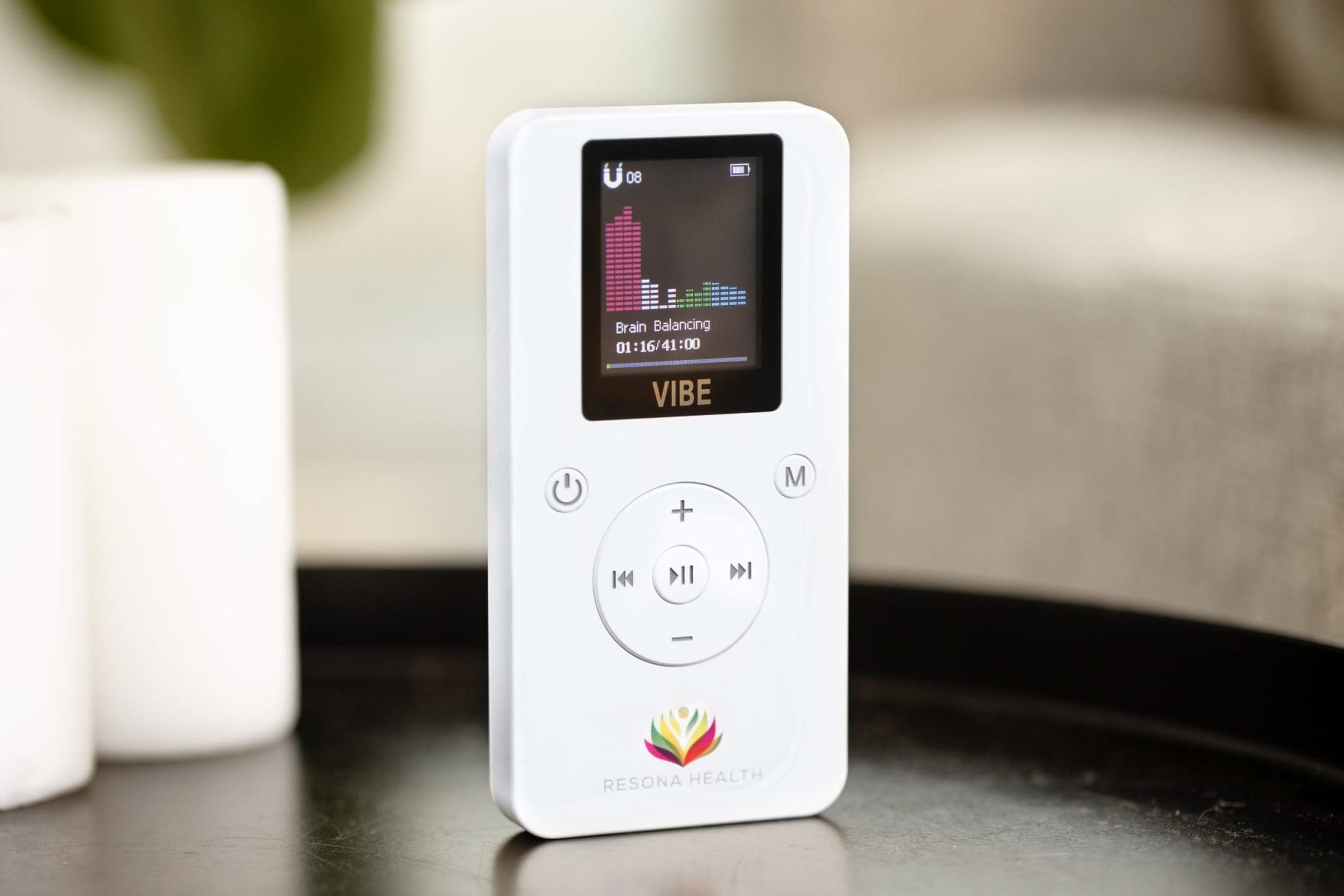
The VIBE vagus nerve stimulator uses pulsed electromagnetic fields to gently activate vagal tone, helping your nervous system downshift into the state where presence becomes possible.
Support your vagus nerve effortlessly
The Stress Hormone Connection
There’s another biological reason practicing presence feels impossible when you’re stressed: cortisol.
Cortisol is your primary stress hormone, released by your adrenal glands when your hypothalamic-pituitary-adrenal (HPA) axis gets activated.11,12
Short bursts of cortisol are fine — that’s normal stress response.
But chronic elevation?
That keeps your brain in threat-detection mode, making it nearly impossible to settle into the present.
Multiple studies show that meditation directly lowers cortisol levels.
One study with medical students found that just four days of mindfulness practice significantly reduced serum cortisol.8
Another long-term study of experienced meditators showed significantly lower cortisol levels and, importantly, faster cortisol recovery after stress exposure.9
That faster recovery is key. Life will still throw stressors at you.
But with regular practice, your system bounces back quicker, spending less time in that cortisol-flooded, future-worried state.
Your 5-Minute Presence Protocol
You don’t need an hour on a meditation cushion. Start with five minutes before Thanksgiving dinner.
The Anchor Breath
Sit comfortably. Feet flat on the floor. Hands in lap.
Begin 6-2-8 breathing: inhale for 6 counts, hold for 2, exhale for 8.
The extended exhale is what activates your vagus nerve and triggers the parasympathetic response.5,6
Do this for five minutes. Your only job is to count.
When your mind wanders — and it will — notice where it went without judgment, then return to counting.
That noticing and returning? That’s the practice. That’s how you train being present.
The Sensory Reset
During dinner, before your first bite, pause. Close your eyes. Take three conscious breaths through your nose.
Now notice five things:
- What do you smell?
- What textures are under your hands?
- What sounds are closest?
- What’s the temperature on your skin?
- What can you taste in your mouth before you even eat?
This drops you immediately into sensory experience, which only happens in the present moment.
Memory and anticipation live in your head. Sensation lives in the now.
When You Drift (And You Will)
Notice your mind has left — maybe you’re replaying a conversation or planning tomorrow.
Don’t judge it. Just feel your feet on the floor. Take three breaths.
Ask yourself: “What’s actually happening right now?”
Not what might happen. Not what did happen. Right now.
Then return to the moment.
This isn’t perfection. It’s practice.
Every time you notice you’ve drifted and come back, you’re strengthening the neural pathways for presence.
Want to learn more practical techniques? Check out these 5 vagus nerve exercises that calm anxiety and improve sleep through better nervous system regulation.
Master the Complete System
Get structured Qigong, breathwork, and meditation training with Temple Grounds. Build unshakeable presence capacity through proven body-based practices.
FREE 2-week trial inside The Urban Monk Academy
Beyond Thanksgiving
Here’s what practicing presence really means:
It means your life stops passing you by while you’re mentally somewhere else.
It means your kids grow up and you actually remember it because you were there.
It means meals taste better.
Conversations go deeper.
Stress hits you, but it doesn’t stick to you for days.
The ancient masters in the Taoist and Buddhist traditions spent thousands of years perfecting these practices not because they wanted to escape life, but because they wanted to fully live it.
Every moment. Even the difficult ones.
Modern neuroscience has simply confirmed what they already knew: your brain can be trained.
Your nervous system can be regulated.
Presence is a skill, not a personality trait.
And like any skill, it improves with consistent practice.
This Thanksgiving, give yourself permission to actually be there.
Not just physically. Fully. The people at your table deserve your presence.
And honestly? So do you.
Sources
- Brewer JA, Worhunsky PD, Gray JR, Tang YY, Weber J, Kober H. Meditation experience is associated with differences in default mode network activity and connectivity. Proceedings of the National Academy of Sciences. 2011.
- Garrison KA, Zeffiro TA, Scheinost D, Constable RT, Brewer JA. Meditation leads to reduced default mode network activity beyond an active task. Cognitive, Affective, & Behavioral Neuroscience. 2015.
- Harvard Health Publishing. Understanding the stress response. Harvard Medical School. Updated April 3, 2024.
- Smith SM, Vale WW. The role of the hypothalamic-pituitary-adrenal axis in neuroendocrine responses to stress. Dialogues in Clinical Neuroscience. 2006.
- Gerritsen RJS, Band GPH. Breath of Life: The Respiratory Vagal Stimulation Model of Contemplative Activity. Frontiers in Human Neuroscience. 2018.
- Magnon V, Dutheil F, Vallet GT. Benefits from one session of deep and slow breathing on vagal tone and anxiety in young and older adults. Scientific Reports. 2021.
- Krygier J, et al.. Mindfulness meditation, well-being, and heart rate variability: A preliminary investigation into the impact of intensive Vipassana meditation. International Journal of Psychophysiology. 2013.
- Turakitwanakan W, Mekseepralard C, Busarakumtragul P. Effects of mindfulness meditation on serum cortisol of medical students. Journal of the Medical Association of Thailand. 2013.
- Gamaiunova L, Brandt PY, Bondolfi G, Kliegel M. Exploration of psychological mechanisms of the reduced stress response in long-term meditation practitioners. Psychoneuroendocrinology. 2019.
- Killingsworth MA, Gilbert DT. A wandering mind is an unhappy mind. Science. 2010.
- Hinds JA, Sanchez ER. The Role of the Hypothalamus–Pituitary–Adrenal (HPA) Axis in Test-Induced Anxiety: Assessments, Physiological Responses, and Molecular Details. Stresses. 2022.
- National Center for Biotechnology Information. Physiology, Cortisol. StatPearls. Updated August 28, 2023.