
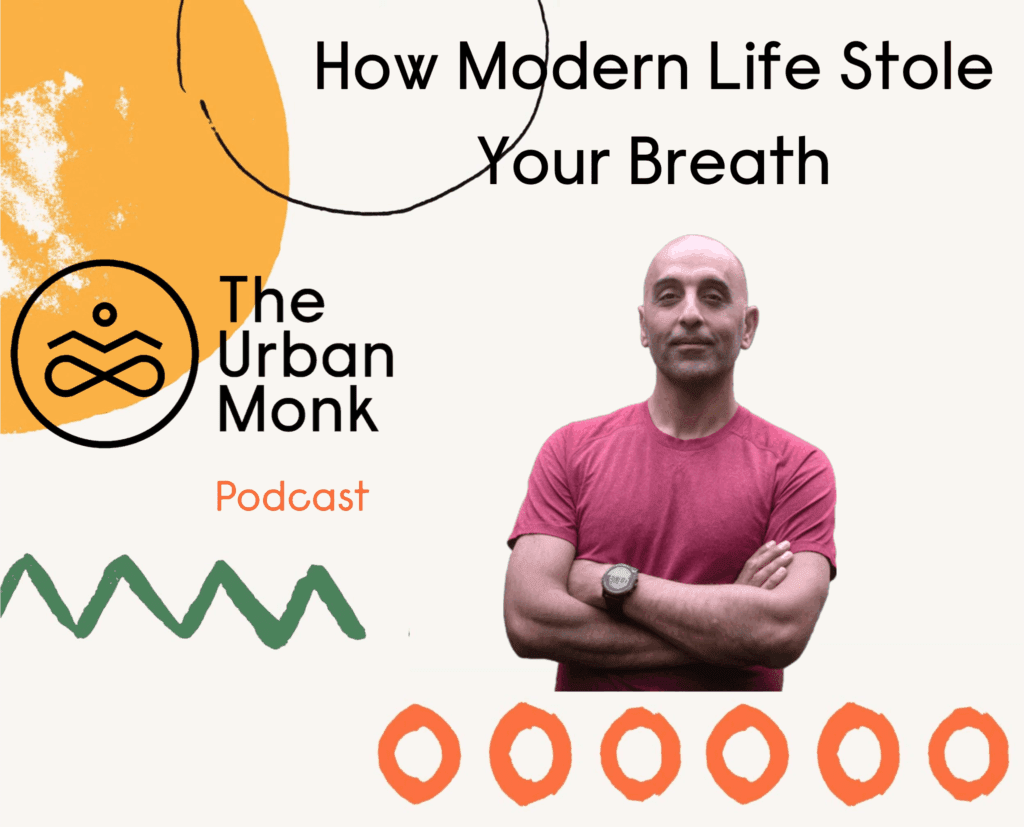
Dr. Pedram Shojai
Episode Description:
Most people breathe 20,000 times a day, yet modern life has systematically broken this fundamental function. Dr. Pedram Shojai reveals how collapsed posture, chronic stress, mouth breathing, and lost body awareness have created a breathing crisis—leaving us in survival mode with shallow, chest-based breathing that signals constant danger to our nervous systems.
In this essential episode, discover the four ways modern life has stolen your breath and why dysfunctional breathing creates cascading physical consequences from chronic anxiety and brain fog to digestive issues, immune dysfunction, and even facial distortions. Learn how your breath serves as the master control panel between your conscious and unconscious mind, and why it’s the foundation upon which all other health practices build.
Dr. Shojai guides you through a practical breathing restoration practice combining postural awareness, nasal breathing, and diaphragmatic techniques that can increase heart rate variability by 15-25% in just weeks. This isn’t about perfection—it’s about becoming a breath researcher and reclaiming control of your autonomic nervous system through the most accessible tool you have.
Listen to the episode on Spotify here or on your favorite podcast platforms and check out the Free 5-Day Reset here.
Podcast show notes:
Introduction: The Breathing Crisis [00:00:00 – 00:02:00]
- The fundamental question: Are you breathing right?
- How modern life systematically stole your breath
- Why most people unconsciously change their breath when attention is drawn to it
- The good news: breath is the fastest, most accessible entry point to transform your nervous system
The Four Ways Modern Life Broke Your Breathing [00:02:00 – 00:06:00]
1. Collapsed Posture [00:03:00]
- How 8-12 hours hunched over screens compresses your diaphragm
- Why your body recruits emergency breathing muscles all day long
- How this signals constant danger to your nervous system
2. Accumulated Stress [00:04:00]
- Chronic low-grade stress keeps you in sympathetic dominance
- How emails, notifications, and deadlines alter your breath
- The toxic cascade of never fully exhaling and CO2 buildup
3. Mouth Breathing Epidemic [00:04:30]
- Causes: allergies, sinus issues, learned habits, even wine consumption
- How mouth breathing bypasses nitric oxide-producing bacteria
- The shocking reality: reduces oxygen delivery by up to 20%
- Connection to sleep apnea and facial structure changes over time
4. Lost Interoceptive Awareness [00:05:30]
- The inability to feel the difference between chest and diaphragmatic breathing
- Breathing 15-20 times per minute instead of the optimal 6-8 times
- Using only 10% of lung capacity while your nervous system thinks you’re being chased
The Devastating Consequences of Dysfunctional Breathing [00:06:00 – 00:10:00]
Physical Consequences [00:07:00]
- Chronic hyperventilation leading to alkalosis, anxiety, brain fog, and muscle tension
- Poor oxygenation causing fatigue and reduced cellular energy
- Diaphragmatic dysfunction creating digestive issues and pelvic floor problems
- Lymphatic stagnation reducing immune function and causing toxin accumulation
- Facial restrictions requiring orthodontics, night guards, and cosmetic surgery
- Fascial restrictions leading to chronic pain and reduced energy conduction
Nervous System Impact [00:08:00]
- Sympathetic dominance preventing access to rest-and-digest mode
- Heart rate variability collapse reducing stress resilience
- Suppressed vagal tone leading to inflammation and poor emotional regulation
- Being locked in fight-flight-freeze state creating chronic anxiety
Effects on Consciousness [00:09:00]
- Fragmented awareness and inability to hold multiple perceptual streams
- Present moment deficit trapping you in thought loops and rumination
- Reduced interoception disconnecting you from body signals
- Why appetite modulation fails (connection to GLP-1 medications)
- How small stressors become overwhelming
The Breath as Bridge [00:10:00 – 00:11:00]
- Why breath is the only part of the autonomic nervous system you can consciously control
- How bringing awareness to breath bridges conscious and unconscious mind
- The connection between voluntary and involuntary systems
- Why nearly all meditation and contemplative traditions leverage this principle
Guided Breathing Restoration Practice [00:11:00 – 00:17:00]
Part 1: Quick Assessment [00:11:00] – 30 seconds
- Hand placement technique to identify chest vs. diaphragmatic breathing
- Non-judgmental awareness of current breathing pattern
Part 2: Postural Setup [00:12:00] – 30 seconds
- Sitting forward on chair with stacked spine
- Crown pulling upward, shoulders relaxed down and back
- Grounding through sit bones
- Noticing how posture alone changes breath
Part 3: Nasal Breathing [00:13:00] – 1 minute
- Closing mouth and breathing only through nose
- Feeling cool air entering, warm air exiting
- Engaging nitric oxide production and air filtration
- Chinese practice: tongue tip touching roof of mouth
Part 4: Diaphragmatic Breathing [00:14:00] – 5 rounds
- Inhale through nose for 4 counts (belly → ribs → chest, like filling a glass)
- Pause for 2 counts at top
- Exhale through nose for 6 counts (belly draws inward, actively pushing air out)
- Pause for 2 counts at bottom in stillness
Part 5: Expanded Awareness [00:15:00] – 1+ minute
- Interoception: Feeling breath temperature, expansion, subtle sensations
- Proprioception: Noticing how posture supports or restricts breath, relationship with gravity
- Exteroception: Awareness of sounds in room, air on skin
- Practicing multi-awareness with breath as anchor
The Science Behind Breathing Restoration [00:17:00 – 00:19:00]
- Heart rate variability increases 15-25% in just weeks
- Improved vagal tone leading to better inflammatory control, emotional regulation, and digestion
- Increased oxygen delivery creating more cellular energy and better brain function
- Improved CO2 tolerance reducing anxiety and enhancing breath control
- Restored diaphragmatic function supporting digestion, pelvic floor, and lymphatic flow
- Why breath is the foundation for all other practices: qigong, meditation, cold exposure, movement
Becoming a Breath Researcher [00:19:00 – 00:20:00]
- Investigation questions for the week ahead:
- When do you hold your breath?
- What situations trigger shallow breathing (conflicts, deadlines, difficult conversations)?
- How does breath change with posture (slumped vs. stacked)?
- What’s the quality of breath upon waking or before bed?
- Building interoceptive awareness as foundation of true consciousness
- Taking breath practice into workouts, phone calls, and real-time daily life
Announcements [00:20:00 – 00:24:00]
- New breathing course launching mid-January: 52 weekly modules covering all this material and more
- Gene Keys book study continuing through late January
- How to use the Gene Keys: consult based on your birthday profile or use as an oracle
- Free diving experience in Thailand and CO2 tolerance training
Q&A [00:23:00 – 00:24:00]
- Question about running out of air during practice
- Recommendation to start with 4-2-4-2 pattern instead of 6-2-6-2
- Building CO2 tolerance capacity over time (typically within one week)
Key Takeaways
- Modern life has created a breathing crisis through collapsed posture, chronic stress, mouth breathing, and lost body awareness
- Dysfunctional breathing creates cascading physical, nervous system, and consciousness consequences
- Your breath is the only part of your autonomic nervous system you can consciously control—making it a bridge between mind and body
- A simple practice combining postural awareness, nasal breathing, and diaphragmatic technique can restore breathing function
- Proper breathing increases heart rate variability 15-25% in weeks and improves vagal tone, oxygen delivery, and CO2 tolerance
- Breath is the foundation upon which all other health and consciousness practices build
Notable Quotes
- “Modern life has systemically stolen your breath through a perfect storm of posture, stress, and environmental factors”
- “Your nervous system thinks you’re being chased by a tiger while you’re sitting at your dumb desk”
- “Your breath is the only part of your autonomic nervous system you can control—it’s the bridge between your conscious and unconscious mind”
- “This isn’t woo woo. This is just taking back control of your autonomic nervous system”
- “If you fix your breathing, you fix the foundation of everything else”
- “Ancient technology we’ve forgotten to use—bring it back”
Resources Mentioned
- The Urban Monk Academy Temple Grounds (breathing practices, qigong, meditation)
- Gene Keys book and website (genekeys.com)
- Upcoming 52-module breathing course (mid-January launch)
This episode is for educational purposes only and not intended as medical advice. Consult with qualified healthcare practitioners for personalized guidance.
www.theurbanmonk.com